| |||||||||
21 ways
to assemble a
| |||||||||||||||||||||||||||||||||||||||||||||||
Who the rig is for:
For people on the go who need higher quality and reliability than off the shelf laptop systems can provide.
Hooking it up:
Simple it is. Firewire cable to the Mac. Monitors on the main outs of the MOTU. Keyboard connects by USB. Mic or guitar into the front panel combo jacks.
|
|
|
Monitors to suit your location |
|
|
Microphone(s) of choice depending on application |
|
|
|
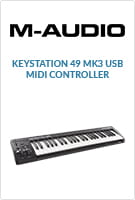
Traveling light is a virtue. Yet this mobile rig has quite a bit of recording power. The Apple MacBook Pro in my opinion provides the kind of reliability that is lacking in many PC laptops. The M-Audio 02 controller is super light and super thin. The MOTU Traveler can run off the computer's bus power or batteries. For the live gigs and hotel sessions you want to record it has up to 20 input channels and 22 output channels in a variety of formats. 4 mic pres and 4 line inputs, ADAT, S/PDIF, AES/EBU and headphones. Build your mix in the park, then go dump it down to digital at any pro studio.
With
Logic Pro
you don't need any additional software. All the softsynths, samplers, processors
and effects are built-in. The new MacBook Pro is far stronger than the old G4 PowerBooks.
The MOTU interfaces are compatible with Apple's new Intel Duo processors and Logic
Pro runs natively on these machines. Today's MacBook Pros and Logic offer
the most powerful laptop DAWS on the planet in my opinion. This is one laptop
solution that can handle professional audio needs.
Who it is for:
Good for recording hip hop, electronica or 2 people at once on laptops. The 1616m has 2 preamps.
Hook Up example:
Insert the card into the cardbus slot on your PC laptop. Connect your mics, keyboard audio out and turntable and monitors into the 1616m interface. Connect the midi out and in of the keyboard to the midi jacks on the 1616m, or if your keyboard uses USB then plug it in that way. Pretty simple huh? Yep! If you add the MPD 16 as I have shown that hooks up to the computer's USB port.
|
|
Studio Monitors of choice, such as the Wharefedale DP82a, or or KRK RPG2 or better |
Rode NT1aOr Studio Projects C1 |
Your choice of software synthesizers and samplersEmu Emulator X2 Software Sampler (Windows) |
Emu Xboard 49 49-Key MIDI Controller |
MPD16 |
A FAST laptop PC with large external drives
|
Headphones of choice |
Turntable of choice |
Sonar Studio or Cubase Studio |
Plugins for masteringOzone (the alternative to expensive mastering plugins) |
Which audio interface to get for a laptop system is a common and difficult question to answer. This is because many laptops are not designed for multi-channel audio. If you have one of these, be real careful as very few products will work. You might have to settle for recording 2 tracks at a time and using hardware synths as I showed you in my entry level mixer based rig. However, if you know you have a powerful laptop made for multichannel audio then you can consider the same firewire and usb 2.0 audio interfaces desktop users enjoy. Of course you can't use PCI because there are no PCI slots on a laptop. But on some laptops you do have a cardbus slot and there are audio interfaces designed just for that slot.
The emu 1616m could make a wonderful core for a PC laptop system. Its got a Cardbus which will give you good audio throughput and it is housed in a breakout box which allows you to get your mics away from the laptop's noisy fan. Note there is also a PCI version of the 1616M which would be a good way to go for desktop PCs.
Following the lead of the older Emu 1820M, the 1616M's connections are balanced and the converters are good too--this will allow you to achieve excellent sound quality. You will have 2 preamps, 4 balanced inputs and 6 balanced outputs. Plus you get 8 channel digital ADAT i/o for adding more preamps, a digital mixer, or syncing a multi track recorder if you want. You can add the Emulator X2 software, connect your turntable, connect an MPD16 or MPD24 and get similar functionality as the hip hop guys using the MPC series samplers.
Remember, with a high powered laptop you still have firewire and USB2 audio interfaces on the table. For a PC I would look at the Presonus Firebox, or a Tascam USB2.0.
Time out: I have to tell you--laptops, Vista, and --any--audio
interface can be problematic. This is dangerous ground. Before you buy go
to the manufacturers website and look for evidence of Vista drivers and updates
to those vista drivers. I highly recommend that you only shop with a store
that has a good return policy. You may have to try several before your find
one that works with your Vista laptop. zZounds by the way has a
great return policy.
I'm going to quote them
"Our 30 day return policy is the most generous in the industry. We allow you to return almost any product for any reason. When returning a product, you can request an identical replacement item, exchange the product for another product, or request a refund. When procedures are followed, there are no restocking fees. " (quoted 1-4-08)
Who it is for:
The person wanting to get started with a Pro Tools Rig who only want to record a track or two at a time. The Mbox2 and Mbox2 Pro are very basic machines. The Mbox Pro is much more capable. Still i/o is limited for the sake of simplicity. Not for bands or for situations where you need more than 2 mics.
Hooking it up:
All the Mboxes are designed for simple setup . The connect to the computer by USB (except for the MBox Pro which connects by Firewire). The Mic connects directly on the back.
|
|
|
|
|
|
|
|
Korg TR61 61-Key Synth Workstation![]() |
|
|
Native Instruments Komplete Synths |
The MBox2 is the least expensive path to Pro Tools. You get a basic audio interface and Pro Tools LE software. It has a built-in MIDI interface which makes it easy to connect a keyboard. Keep in mind this is a 2x2 (4x4 if you count s/pdif) USB 1.1 audio interface, so we are talking about recording a mono or stereo track at a time here. If you are connecting to a laptop you can help things out by getting a MIDI keyboard with sounds, but if you are on a fast desktop you can get away with a soundless controller. Keeping the expense reasonable, I've selected the NI Komplete Synths pack, which will give you the sonically adventurous Absynth 4, Massive, the FM8 which is the softsynth model of the classic Yamaha DX7 and TX/TG family, and finally the Pro 53 soft synth emulation of the venerable Prophet 5. This is a good way to get into Pro Tools LE on a budget.
For those who can take it another step, Digidesign now has recently released the Mbox Pro, which uses firewire, rather than USB 1.1. This is a much faster pipe for audio to travel down, so you can expect to get more tracks to record and playback simultaneously. You also get more inputs and outputs.
For those on more limited gear budgets, there is the USB 1.1 Mbox Mini
Always check for compatibility with any audio interface. Digidesign gear has exacting requirements, so read up on their website, make sure your computer qualifies.
Hooking it up: You should be getting the picture by now, no? Mbox 2 is USB, your Mic goes into XLR, your keyboard, if USB connects to the computer, if not, direct to the Mbox2.
Who its For:
The Pro Tools LE rig is ideally for the professional person using Pro Tools HD at a commercial studio who wants to work at home. However, it has caught on as a complete solution in itself for home producers.
Hooking it Up:
Much like the Tascam FW1884 and Project Mix, the Digi 003 connects by Firewire to the host computer. Instruments plug directly in on the back of the 003. There are 8 analog ins (4 of which are Mic preamps) and outs, ADAT and S/Pdif. One MIDI in and 2 outs are provided. So your mics and keyboards can all connect direct to the 003.
|
|
|
|
|
|
Digidesign Pro Tools LE Upgrade if needed |
Native Instruments Komplete Synths |
|
|
|
|
PreSonus DigiMAX LT 8-Channel Microphone Preamp with Digital Output add 8 more preamps to the 002 ADAT input |
Reason Adapted Upgrade |
Suitable studio Monitors |
Keyboard of choiceMAudio Axiom 49 Keyboard MIDI Controller |
||
So, you ask, as has been asked innumerable times, should i go with Pro Tools? Its quite a difficult decision for some. Pro Tools, loosely, refers to a high end, and very expensive, system of hardware and software made by Digidesign made for professional recording studios. The name, Pro Tools, is HUGE in the biz as feature films, TV shows and commercials and yep, top 40 radio are often produced on big Pro Tools rigs.
The Digi 003 is, in one sense, a device that allows Pro Tools users to do stuff at home and later take sessions back to their studio and port it over to the "real thing". What you get with the Digi 002 systems is a hardware audio interface and Pro Tools LE software. Of course it works fine by itself, you don't need a $300,000 Pro Tools rig. The main question to ask is do you need Pro Tools compatibility? If you have a contract with a studio that has Pro Tools you would be outright mad not to get an 003. But if you don't, you'll find you will be paying a bit more for a system that can be seen as less flexible than Cubase, Sonar, Logic.
All the same, its a popular system. In particular, the Pro Tools LE systems have caught on in the hip hop world, has great sound, and has what you need to producing fast. Make sure your computer is "qualified" to run Pro Tools LE--older systems may not be. You can check that out at their website. Both Macs and PCs are compatible but there may be a delay before support for the latest OS is offered.
The 003 and the 003r offers 8x8 analog i/o which includes 4 mic preamps. It also has an ADAT 8 channel digital out and stereo S/PDIF. It also has MIDI i/o. It connects by firewire.
Go to the Previous Page
Want to Discuss this topic? Go to the CONFIGURING your RIG Forum
|
TweakHeadz Lab | Studio-Central | Audio-Pro-Central | zZounds and online store Affiliations | Site Map | Support the Lab | Privacy Policy | ©2008 TweakHeadz.com |