|
Microphones
|
| Microphones at zZounds
Rode NT 1a
Studio Projects C1 Large Diaphragm Condenser Microphone Shure SM81LC Cardioid Condenser Microphone
ElectroVoice RE20 Classic Cardioid Dynamic Microphone
The AT822 is ideal for DAT recording as well as television, FM, and field applications. Its compact, lightweight design is perfect for camera-mount use. Tweak: pricey, but when you need a stereo mic, you need one.
Shure SM7B Dynamic Cardioid Studio Vocal Microphone
AKG C414 B-XL II 5-Pattern Condenser Microphone
Studio Projects B1 Large Diaphragm Condenser Microphone
The KSM44/SL is a multiple pattern (cardioid, large diaphragm condenser microphone with extremely low self-noise (7dB). Developed to meet the needs of studio recording musicians, the warm, rich sound of the KSM44 delivers exceptional performance, tailored to deliver vivid reproduction of voice for the most critical recordings. Read the KSM44 User Guide Official Shure site |
|
|
Drum Mics n Stuff
AKG D112 Large Diaphragm Microphone
AKG Deluxe Drum Mic Package (Includes D112, 3xC418, C419 in a Case)
Studio Projects C4 Condenser Microphone
Neumann KM184 Cardioid Small Diaphram Microphone
Shure Drum Microphone Package
Audix DR456 Drum Microphone Combo Pack (4xi5, 1xD6, 4xDVice) |
Neumann U87 Anniversary Microphone In celebration of their Anniversary Neumann presents their Special Limited Edition Anniversary U87 Mic Set in a brilliant Nickle finish. Included in the set is the U87 Mic, Shockmount, Windscreen, Bag and a special gift box.
Welcome to Tweak's class on Microphones! Will the newbies please sit up in the front few rows? Sorry dudes, only the pros can sit in the back. They already know this stuff. None of it is rocket science, even those sweaty drummers can figure it out. Any drummers here? A few ape-like figures make a displeased grunt. "Oops!" But you'll be glad you came, there's a section on basics for miking drums.
|
Browse Microphones by Type in Tweak's Microphone Room |
Okay! Now that you are
up close, this Mic here can pick up any sound you make. By getting close to
the Mic more of the direct sound is recorded and less of the reflected "hall tone"
or room tone. Do rooms make a sound? Yep! Once you start using
a quality microphone, you won't believe how noisy your home studio room is.
So tip #1 is always to get as close to the source as you can and do your best to
remove unwanted sounds from creeping in. The best condenser mics in the world
can't help--they can actually make it worse because they are so sensitive, they
pick up everything, even the sound of "air". You can improve the sound of
any microphone by proper placement and reducing environmental noises.
With all the modern marvels that
have been introduced in the last decade for our studios it may seem strange that
the microphone has changed the least. A quick peek to the high end
shows that some microphone designs used today were formulated in the late 60's,
that's forty years ago! Since then countless models have been introduced,
copied, resurrected and repackaged with small refinements. Few areas of the
recording studio have been as hotly debated as to which is "best" for a particularly
recording application. Some of this is hype and some of this is not and it
can be difficult to sort through the mazes of issues. What I hope to do here
is to give you some common references so you can at least talk about mics and their
differences, and give you a useable roadmap for making decisions for your studio.

Like any other piece of gear, the same microphone can give tremendously different
results depending on how it is used. There is a bit of expertise and experimentation
that needs to happen when placing the microphone to capture a source. Even
the best mics in the world will sound boomy and unusable if the vocalist gets too
close. This same mic might fail miserably if recording an acoustic guitar
if placed too far away, or off axis (angled away from the source). An inexpensive
mic, placed optimally for the task at hand can capture exceptional nuances, and
once a track is treated with EQs, compressors and plugins, the results can be outstanding.
Yet a great mic. with an excellent preamp, given the same care during setup and
post-treatment can be absolutely stellar.
The Electrovoice RE20 is one of my favorites
Like anything
worth doing, getting the best results takes a bit of practice, experimentation and
work. Yet the chances of getting a great take are consistently better with
a high quality microphone. Yet price and quality do not always match.
Moreso in the area of microphones than any other piece of gear, you can spend a
lot of money and get something that you don't like, or spend a modest amount to
get something you like a lot. What are the duds? Which are the truly
great finds? None of the mics listed to the left are duds, though the prices
vary from under $100 to over $2000. Note that I have not listed low-priced
"value" mics. If you are tempted to go to the sub $50 range of mic, I highly
recommend saving up and going for an SM57, Here's a page listing all the
mics under $100
Poll: best large condenser mic around $100
First of all, lets get real. Your home or project studio is not a pro studio. You probably don't have to be ready for any recording situation that comes up. Face it, your studio is probably not in competition with the Record Plant or Abbey Road. You probably record the same instruments over an over. Probably vocals, guitars, drums, amp cabinets and perhaps a few unique instruments you have. Point #1: Make a list of the things you record. At the TweakLab, for example, I record male and female vocalists, my acoustic guitars, amps, lots of hand drums, various world percussion and some exotic flutes and strings. For my needs, a large condenser and a dynamic for vocals, flutes, a small condenser for acoustic strings, drums and delicate things, a dynamic for general purpose stuff and miking amps, and an omnidirectional stereo mic for location and sampling. That is my list. Yours is going to vary, of course.
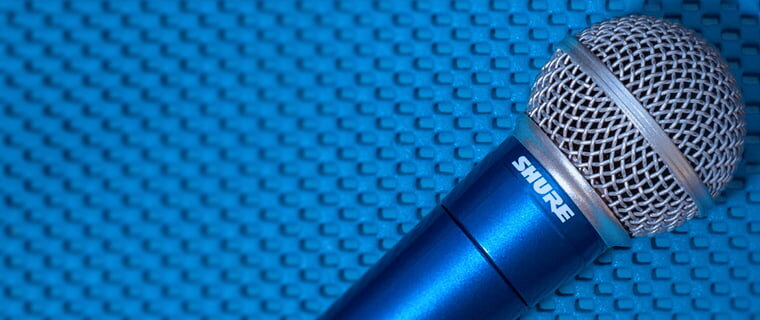
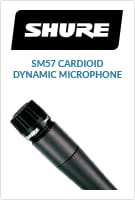
I started my mic cabinet with the legendary workhorse, the all-purpose stage hammer, yes, the Shure SM57. If it's all you have, you can use it to record everything, though for vocals and acoustic guitars, it is happiest with a good preamp. For recording your amp or really loud stuff, it will resist breakup even under extreme pressure. For vocals my first condenser was a Rode NT1, which is now replaced by the NT1a. Once you have both a dynamic and a large condenser working for you, you have a lot of recording ground covered well. Condensers shine on vocals, acoustic stuff--anything that has lots of high crystalline frequencies. A third mic for me was a small condenser--the Shure SM81. More expensive than many, but I wanted high quality acoustic guitar recordings. Those 3 mics make a great basic mic cabinet for a home studio.
Of course, you can go farther into this, with better and more specialized mics. Two dynamic mics that I love are the ElectroVoice RE20 and the Sennheiser MD421II. These are often used as broadcast mics but do well for strong vocalists and other instruments that blat and blast.
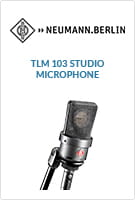
As you start moving towards professional studio sound, you may move towards professional mics as well. Here we are talking about the Neumann line, with their least expensive, but great, TLM 103, the pro pop vocal standard U87a, and others. Another vocal standard among pros, the AKG C414. Of course there are many others, and pro studios may have 10-50 mics in this caliber. But for the home studio, I think it is a good idea to aspire to at least one of these. Call it your crown jewel, take care of it and it will last a long time.
I should point out
that microphones sound better with excellent
preamps. To get the realize
the full subtlety and nuance that a fine mic provides, it needs clean, quiet, gain,
or amplification. But you will hear a huge difference between condensers and
dynamics even with the cheaper preamps tacked on to audio interfaces.
Is this an art or a science? A little of both, but often, just a matter of experimenting till something grabs you. I've done extensive mic placement when sampling instruments for my sample cd roms and recording vocalists. For every sample that makes the final cut on one of my cd roms, I will have over 100 source samples recorded. Consider the microphone to be an ear. To hear the finest nuances of any instrument, you have to point the ear in a way that the sound vibrations "hit" the diaphragm of the mic jus right. So I put my wave recorder in record and go to the instrument, play some hits, move the mic, play some hits, move the mic, play some hits---get the idea. When I get back to the waveform editor, I will find that one position sounded better than all the rest and within that position there is one sample that rings clear and true with unmistakable quality.
|
Do Mics really sound different? Yes. Every mic "colors" the sound in one way or another, much like the way speakers color the sound of your home stereo. Some mics try to be "transparent" but this is not always desirable. With vocals and many instruments, for example, you want a mic with some presence boost for that pro-sounding "sheen". What is this directional pattern nonsense? What are you? a Drummer? Then you above all need a uni-directional mic so when close miking they pick of what it is pointing at, not everything in the room, like an omni directional mic does. Cardioid mics are directional because they pick up everything in the heart-shaped pattern in front of the mic. A Bi-directional pattern is also called a "figure 8" pattern cause that is how it looks on a graph. You can record from the front and back but not the sides. What is Phantom Power? Condenser mics output a weak signal that must be boosted so the mixer's preamp can boost it further into a useable signal. Some condenser mics use batteries to do this. Other's rely on getting this power from the mixing board. Boards that feature phantom power send a voltage down the mic cable to the mic which is used to amplify the signal there. The signal then arrives at the preamp and is further amped. Dynamic mics do not need phantom power. You can read more in the forums about it and in this article by Shure What's a -10 pad? A Pad refers to attenuation, or a lowering of volume, output or loudness. A -10 pad reduces the sensitivity of the microphone by 10 decibels so it can withstand louder sounds like drums, cymbals, screaming vocalists and other awfully loud things. Some mics may have -20 pads or -15 pads. You normally cannot adjust this--its on or off. What's Bass Roll-off? Some mics have a switch that cuts the lower bass frequencies that the mic pics up. Why? When you record with a quality microphone you will find there is more bass in your environment than you thought. If you are recording close to an ventilation system vent you will find that even a normal rush of air coming out is enough to make a thundering wind boom. Traffic, railroads, airplanes even if far away can be picked up. Finally, a big problem in the mix is getting rid of unwanted bass. it sometimes makes sense to get rid of it at the source. Many mixers have bass rolloff switches on preamps, so if the mic does not have it it is usually no big deal. |
| Check out
all the Mics at zZounds
|
With drums in particular, having
2 mics set up is ideal. Recording in stereo, the close mic, which captures
all the nuances close to the instrument, may be set up within 6 inches of the source,
depending how loud it is. The Room Mic might be a few feet back and pointed
anywhere. The farther away it is, the "longer" the sound becomes. If
you are trying to get killer snares and rock toms, for example, you want to move
these out quite a bit. This will give you a natural sounding reverb that only
expensive effects boxes and plugins can deliver.
Vocals The human voice evokes our attention like no other sounds. Are ears are acutely sensitive to very tiny inflections in the air around the vocalist. The goal of the microphone is to capture the innermost soul of the vocal. Our ears are conditioned to want to hear a slight treble presence coloration on a typical voice. So accuracy alone is really not the name of the game hear. Its accuracy plus good sounding coloration with high definition presence that is not bright, but warm. Large capsule condenser mics often get the call. So do dynamics, especially with vocalists that get loud. Condensers can distort if a loud vocalist gets too close. Dynamics are also a good choice for rooms with a lot of ambient noise. In fact, if you are recording in an ugly sounding reflective room, you have a good argument for choosing a quality dynamic mic to minimize interaction with the room.
What you need to watch out for when buying your first Mic
Assuming you understand the basic mic differences, make sure of two things before you buy.
1. If buying a condenser mic, be sure you have +48v phantom power on your preamp.
2. If buying a dynamic mic, you don't need phantom power, you need gain on your preamp. The SM57 and other dynamic mics need plenty of gain to get a good level, about 55-60 db. Some of the newer inexpensive audio interfaces are designed for condensers which need about 40-45db. Most mixers can handle the SM57. A typical preamp with 60db of gain is fine. If all you have are the preamps on your gain-challenged audio interface, and you can only pop for one mic, make is a large condenser. On a budget around $100 smackers, the Studio Projects B1 is perhaps the best game in town.
Acoustic instruments I can talk about acoustic guitars best as I have been recording them a long time with numerous techniques and types of microphones. I shoot for 3 things when recording acoustic guitar. The sound of the pick hitting the strings, the "wooden" sound of the body and a sense of pressure and movement coming from the strumming hand. Though it breaks with studio wisdom, I have found awesome results mixing and matching different mics, such as PZM with dynamics, condensers with electrets when trying to capture a stereo image of the acoustic, taking time to experiment and place the mics to get the most out of them. And it pays to try the traditional techniques such as the X-Y technique, where two mics have their capsules very close (without touching) pointing to the instrument at a 90 degree angle from each other. There is also the stereo 3-1 rule, which has it that if the Left Mic is 1 foot from the source, then the right mic must also be 1 foot from the source but three feet from the 1st Mic. Finally, there is ORTF, where the mics cross each other ay a 110 degree angle, (instead of pointing at each other at a 90 degree angle like XY) which is good for recording at a greater distance, like in front of a stage. I've also realized great results with a single condenser.
|
Sampling and "On Location"
Recording Samplists need a stereo Mic. Or need to set up
2 mics to capture what the are sampling. Back in the studio, when
editing samples, you might decide that either the left side or the right
side or both are keepers. But you do want to have the option to 2
takes per sample. Your odds of getting a better sample are increased.
Recording ambient environments is also a job for stereo. Here a matched
stereo pair or a stereo mic is important because you know you want to preserve
the stereo image in the final sample. I've tried many techniques with
great results. One favorite, though hard to do, is with 2 PZM mics
taped to opposite sides of a big piece of plywood. That's separation!
For outdoor ambience, try placing mics as far apart as your cables will
let you. Objects in the stereo field appear extremely wide due to
the delay from one source to another. Finally, you don't always want
people to know you are recording. For stealth mode sampling I've attached
tie clip mics to my trouser pockets, stuck stereo condenser mics in backpacks
with the head sticking out a little, and used minidisk recorders and cassette
recorders with small cheap mics. |
Here's the basics in 3 paragraphs. I'll cover as much as possible, but note this is just a primer. Opinion varies widely on the best way to do this. How many mics? What gets its own mic? You might be surprised to find out if you could poll some top engineers that some famous rock songs have been recorded with as few as three mics, one directly in front of the kick drum and two overheads panned hard left and right to capture a natural stereo image. However, if you plan to do extensive processing of kiks, snares and toms, you may need to have a mic for each. Also, note that you don't have to capture the drums all at once. You can overdub the snare later.
In general, you need a mics that,
above all, can handle a high SPL (sound pressure level). The loud dynamic
hits will cause distortion at the output. This is really the case with sampling
drums, where you want to stick the mic as close as possible to get the high frequencies
of the "Thwack". Some mics come with a -10 pad. This may be in the form
of a switch or an additional capsule you screw in to the housing. Either way,
the pad will filter down the input into a more reasonable useful signal.
The Kik Mic has to be
able to handle hi SPL and low frequencies. Many a condenser will distort like
madness here, so dynamic mics get the call. Popular Kickin' mics are the
AKG D12, Shure SM57 and Beyer M88. It can be placed a few inches away from
the front kick drum head or sometimes engineers place them inside the drum. The
Snare mic too has to handle hi demand, SPL wise. And it should be rugged.
Drummers pack a real wallop into their hits and many times they will accidentally
slam right into the mic, if placed anywhere near the snare (a good argument for
placing the mic under the snare). The SM57 is a great mic for this. Other
fine mics for snares are the AKG 414eb and the Sennheiser MD421. Overhead
mics need to pick up the whole kit from a greater distance, so they can be more
sensitive, but it still helps to have one with a pad. Condenser mics
usually get the call. Small condensers are a good choice.
For Toms, the Sennheiser 421 is usually a top recommend. Miking cymbals
can be done with condenser mics to capture the hi frequency shimmer, but again be
advised to get one with a -10 pad and cymbals have a lot of sustained sound energy.
|
For the Studio which dynamic mic under $130 |
||||||||||||
|
You might
be wondering how studio keep the hi hat sound out of the snare mic, something called
"bleed". The mics directional pattern comes in here. You want your close
drum mics to reject all sounds except the drum its pointed to. There will
always be some bleed, but you work to minimize it when you set up the mics.
That is the art and science of drum mic placement made simple. Some producers
use noise gates after the Mic preamp. The gate can be set to cut out
all of the signal unless it get a really loud burst. That takes a bit of trial
and error to set up, but if done well it can improve the separation at the board.
That way you can, for example, add a big sounding reverb to just the snare as many
70's rock ballads did, or further process your snare with lower mid frequency eq
for a contemporary trash sound.
All these choices! The difficulty for may startup home studios is deciding whether to go with just one super quality microphone or getting several less expensive mics. If your option #1 was to get the Neumann U87, for the same money you could get a CAD e200, Sennheiser MD421II, a Shure SM81 LC, an AT 822 stereo, and half a dozen SM57s, enough to get a pro studio off the ground. But a home studio doesn't need lots of mics, particularly if you are not recording drums. In that case, maybe just a couple of good ones will make on happiest in the long run. Another buying issue is going with a lower cost large condenser, say, the Rode NT1a. If you one day decide to get a better large condenser, the Rode may become unused or a dead investment. Fortunately, mics, unlike synths, samplers and computers, retain their resale value quite well, especially on the higher end. Some solid advice for a newbie is to get a Shure SM57 first. It will do it all. Then as funds permit, get a large condenser for vocals, a small condenser for delicate instruments. You will have the majority of recording situations covered and you will appreciate how each different mic contributes its own signature to the final mix.
Visit Studio-Central's GREAT Mic and preamp forumJoin the discussion at Studio-Central!
Reviews of Microphones by Tweak
Cool threads at Studio-central
|
Go to the Next Class
Go to the Previous Class
|
Cool Quote: "Keep it simple, keep it sexy, keep it sad". Mitch Miller |
[ About Microphones and Preamps ] [ Build a Home Studio Mic Cabinet ] [ How the Preamp Affects Audio Quality ] [ Shure SM57 ] [ Shure SM81 ] [ Sennhesier MD421 ] [ Review of the Shure SM7b ] [ ElectroVoice RE-20 ] [ Rode NT1 ] [ Neumann TLM 103 ] [ Solaris ] [ CAD E-200 ] [ Great River ME1-NV ] [ FMR RNP ] [ Focusrite Voicemaster Pro ] [ Poll: Best Condenser Under $200 ] [ Best Large Condenser $100 ] [ Best Preamp $800-$3000 ] [ Best Preamp $400-700 ] [ Hi End Preamps ]
|
TweakHeadz Lab
Studio-Central
Audio-Pro-Central |